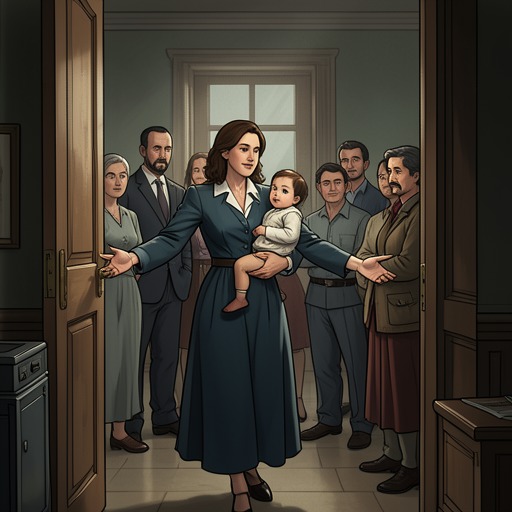
Ava decided to stay with the child and secretly evaluate Gabriel
My Hot Secret: Geheimes Baby mit dem CEO Milliardär - Enemies to Lovers (German Edition)Ava decides to continue her unexpected pregnancy while secretly assessing whether Gabriel can become a responsible father. The event is decisive because it converts a moment of fear into a deliberate life choice, yet refuses to make that choice depend immediately on a man she barely knows. Her plan gives the developing relationship a hidden ethical and practical stake: Gabriel believes he is being invited back into Ava’s life as a friend, while Ava is quietly determining whether he belongs in the life of her child.
The Pregnancy and the Choice
Ava reveals the pregnancy to Beverly after taking time to collect herself. Saying aloud that she has just learned she is pregnant makes the fact more real, and Beverly responds without trying to direct the decision. Beverly tells her that continuing the pregnancy would be acceptable and that abortion would also be acceptable, emphasizing that the choice belongs to Ava. The exchange places Ava’s decision within personal autonomy rather than obligation to a partner, family expectation, or social judgment.
Ava initially cannot identify what she wants. The pregnancy threatens to change every practical feature of her life, especially her ability to travel, and she recognizes that a baby cannot simply be carried across the country as part of a mobile consulting career. The decision therefore involves more than emotion: it raises questions about work, housing, money, and the kind of security she can provide. Beverly’s support gives Ava room to weigh those consequences without treating uncertainty as failure.
The choice becomes clearer when Ava confronts the history of her grief. Before her fiancé died, the two had discussed having children, and the loss had taught her to protect herself by shutting down and suppressing painful memories. She had also run from Gabriel when she felt herself beginning to open emotionally. Yet the connection with Gabriel awakened a desire that had been absent since her fiancé’s death: Ava wanted love in her life again and no longer wanted to flee from it. She consequently tells Beverly that she believes she wants to keep the baby, and Beverly answers with confidence that Ava will be a good mother.
The Secret Assessment of Gabriel
Once Ava chooses the pregnancy, Gabriel becomes the central unresolved question. She knows him mainly through one night of sex and cannot treat that encounter as evidence that he is ready for parenthood. His convertible, relaxed manner, and unconventional apartment suggest to her a free-spirited life, while his work as a baker leaves her uncertain about his financial prospects and long-term capacity to support a child. Ava does not condemn his profession, but she recognizes that raising a baby requires more than biological participation.
Ava therefore develops a conditional plan. She will get to know Gabriel better without telling him that she is pregnant. There is still time before the birth, and she intends to use that period to observe whether he has the qualities of a good father. If he proves capable of meeting the responsibility, she will tell him. If he does not, she will disappear from his life and leave him undisturbed rather than force him into an unwanted role.
The secrecy is also Ava’s attempt to prevent what she sees as a potentially destructive obligation. She knows that she forgot her birth-control pill and told Gabriel not to use a condom, so she regards the pregnancy as her responsibility. She would rather raise the child alone than involve an unwilling father and make both their lives miserable. At the same time, the plan reveals her defensive logic: she wants to protect the baby from a bad father, but she also wants to protect herself from depending on someone whose character she has not yet established.
Testing Through Ordinary Encounters
Ava’s assessment takes place through seemingly ordinary interactions rather than a formal confrontation. When Gabriel invites her to dinner, she accepts only on the condition that they go as friends. The boundary is directed both at him and at herself, because the attraction between them remains strong and she has already recognized the danger of allowing desire to outrun judgment.
Gabriel’s circumstances repeatedly complicate Ava’s assumptions. She learns that he is not merely working in a bakery: he is the owner and says that he is the boss. The discovery gives concrete substance to the financial question that had troubled her. His prosperity is not presented through a conventional corporate identity, and Ava must revise her initial impression of him as an unserious freelancer. His bakery becomes evidence that his apparent freedom may coexist with competence and economic stability.
Gabriel also explains his attitude toward money and pleasure. He sees little point in hoarding money when it can make the present more enjoyable, provided a person can afford the expenditure. Ava finds the outlook difficult not to regard as selfish because her career has required her to move from company to company without certainty about the next paycheck. Gabriel’s flourishing bakery may give him a security she does not possess. Their disagreement thus becomes part of her evaluation: she is comparing not only his income but also his philosophy of responsibility, provision, and living in the present.
The pregnancy remains physically present even while it is concealed. At breakfast during the trip, Gabriel notices that Ava is barely eating and asks whether everything is all right, offering to let her order something else if the food is unappealing. When she says she is simply not a breakfast person, he accepts the explanation but still prepares snacks in his backpack in case she becomes hungry during the hike. His response does not prove that he knows about the pregnancy; he does not. It nevertheless demonstrates attention to her immediate needs without demanding an explanation.
That pattern becomes clearer on the Napa Valley Wine Train. When champagne is offered, Ava refuses it, and Gabriel refuses as well because he does not want the smell to make her feel sick again. He does not know why alcohol or its smell troubles her, and he neither interrogates her nor pressures her to explain. To Ava, the gesture is small but powerful: Gabriel behaves as though attending to another person’s needs is natural. The concealed fact gives his ordinary consideration an additional significance, because Ava is watching for precisely the kind of responsive care that parenthood will require.
Disclosure and the Change in Stakes
The secret assessment eventually reaches its limit when Ava tells Gabriel that she is pregnant. She holds onto his shirt and hopes he will not pull away, but his smile disappears and his fingers slip from her necklace. His shocked response confirms the risk Ava had been managing through secrecy: disclosure can transform attraction and friendship into responsibility, fear, or rejection in an instant.
Gabriel ultimately frames the news as a reason to change rather than retreat. He says that he no longer wants to be the kind of man who evades responsibility or teaches their child to run away from problems. He then connects fatherhood to his relationship with Harvest Foods International, declaring that he intends to regain control of the company and transform it from a symbol of his father’s abandonment into something positive. The pregnancy consequently expands beyond private family planning and becomes tied to Gabriel’s confrontation with inherited injury, business responsibility, and the model he wishes to offer the child.
Ava’s decision also changes the meaning of Gabriel’s earlier acts of care. His offer of food, refusal to drink champagne so that she would not feel ill, and willingness to respect her friends-only boundary had been part of her quiet investigation. After disclosure, those acts can be read as the beginning of a reciprocal ethic of care rather than merely evidence in a private test. Gabriel’s stated commitment does not erase the uncertainty that prompted Ava’s plan, but it supplies the response she had been waiting to evaluate.
Narrative Significance
This event shifts the story from an unplanned pregnancy toward conscious family formation. Ava does not initially make Gabriel the condition of continuing the pregnancy; she chooses the child first and treats his participation as something he must demonstrate through conduct. Her independence remains intact even as she acknowledges a renewed desire for love, and her plan separates reproductive autonomy from romantic optimism while leaving open the possibility of shared parenthood.
The event also establishes a contrast between Ava’s protective withdrawal and the care she wants to build. After losing her fiancé, she had treated love as a source of inevitable pain and responded to vulnerability by closing herself off. The pregnancy forces that strategy into the open. She must decide whether safety means isolation or whether a safer future can be created through careful testing, honest disclosure, and sustained responsibility. Gabriel’s later commitment to the child and to HFI gives the decision its outward consequence, but the decisive act remains Ava’s: she chooses life, accepts the work of protecting it, and refuses to let fear make the choice for her.